
Plausible and Umami are the two tools I recommend most when someone asks me to replace Google Analytics. They’re both excellent — but they’re built for different people.
I’ve deployed both on production sites, tested them across dozens of client projects, and watched teams adopt each one. This comparison is based on that real-world experience, not feature-list skimming.
If you’re looking for a privacy-first analytics tool and you’ve narrowed it down to these two, this guide will help you make the right call.
Quick Comparison
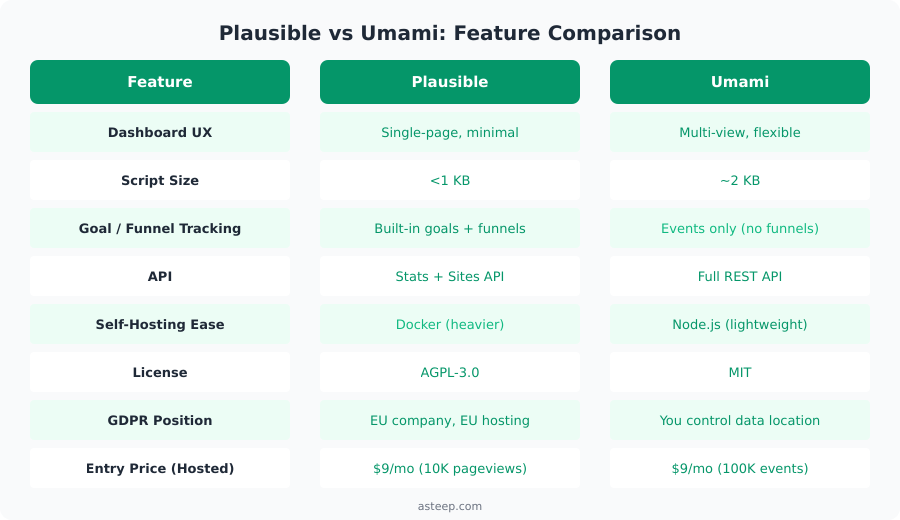
| Feature | Plausible | Umami |
|---|---|---|
| Pricing | From $9/mo (hosted) | Free (self-hosted) or from $9/mo (Cloud) |
| Hosting | Cloud or self-hosted | Cloud or self-hosted |
| Open Source | Yes (AGPL-3.0) | Yes (MIT) |
| GDPR Compliant | Yes, no cookies | Yes, no cookies |
| API | Stats API + Sites API | Full REST API |
| Custom Events | Yes | Yes |
| Goal Tracking | Built-in goals & funnels | Events + manual setup |
| Best For | Teams wanting a polished, managed solution | Developers wanting full control and flexibility |
Plausible: What You Get
Plausible is a European-built analytics platform that prioritises simplicity and privacy. It was founded in 2019, and it has grown into one of the most popular GA alternatives for good reason.
The dashboard is a single page. You open it, and everything you need is right there — visitor counts, sources, pages, locations, devices. No navigation, no drill-down rabbit holes. What I tell clients is: if your team finds GA confusing, Plausible will feel like a relief.
Plausible’s tracking script is under 1 KB. That’s not a typo. It’s lightweight enough that it has zero measurable impact on page load times. And because it doesn’t use cookies, you don’t need a cookie consent banner for it.
The hosted version starts at $9/month for up to 10K pageviews. You can also self-host using their Community Edition, though it requires some Docker knowledge and you’ll manage your own infrastructure.
Key strengths:
- One-page dashboard that non-technical stakeholders actually use
- Built-in goal tracking, custom events, and funnel analysis
- Revenue tracking for e-commerce
- Email reports and Slack integrations out of the box
- EU-owned company with EU-hosted data
Umami: What You Get
Umami takes a different approach. It’s developer-first, MIT-licensed, and designed to be self-hosted from day one. If you want total ownership of your analytics data and infrastructure, Umami is built for that.
The dashboard is clean and well-organised, though it gives you more to work with than Plausible does. You get real-time visitor views, customisable date ranges, and the ability to track multiple websites from a single installation.
I’ve set up Umami on a $5/month VPS and had it running reliably for over a year with minimal maintenance. The resource footprint is small — it runs on Node.js with either MySQL or PostgreSQL as the backend.
Umami Cloud launched as a hosted option if you’d rather not manage servers. Pricing starts at $9/month, making it comparable to Plausible’s hosted offering.
Key strengths:
- MIT license — no restrictions on modification or distribution
- Lightweight self-hosting with low resource requirements
- Full REST API for building custom integrations
- Multi-site management from a single dashboard
- Team accounts with role-based access
- Custom event tracking with flexible properties
Feature-by-Feature Breakdown
Dashboard and UX
Plausible wins on simplicity. The single-page dashboard is genuinely one of the best UX decisions in the analytics space. You can share it with a marketing manager who’s never touched an analytics tool, and they’ll understand what they’re looking at within seconds.
Umami is still clean, but it’s more of a traditional dashboard. Multiple views, more tabs, more options. That’s not a weakness — it’s a trade-off. You get more flexibility, but new users need a few extra minutes to orient themselves.
In my experience, Plausible is better for teams where non-technical people need to check analytics regularly. Umami is better when the person managing analytics is comfortable with a more feature-rich interface.
Event and Goal Tracking
Both tools support custom event tracking, but they approach it differently.
Plausible has a built-in goals system. You define goals in the dashboard (pageview goals, custom event goals, or revenue goals), and they show up automatically in your reports. They also added funnel analysis, which lets you track multi-step conversion paths. If you’re doing conversion rate optimisation, Plausible’s goal system is ready to go without much configuration. My full Plausible setup guide covers goals, custom properties and the proxy in detail.
Umami tracks events using a JavaScript API or data attributes. It’s flexible — you can pass custom properties with each event — but you’ll need to build your own reporting views or use the API to analyse conversion funnels. There’s no built-in funnel visualisation (yet).
For most marketing teams, Plausible’s approach is faster to set up and easier to interpret. For developers who want to pipe event data into other systems, Umami’s API-first approach gives you more room to build.
Privacy and Compliance
Both tools are strong here. Neither uses cookies, neither collects personal data, and both are designed around data minimisation principles.
Plausible is incorporated in the EU (Estonia) and processes all data on EU-owned infrastructure. They’ve published a detailed data policy explaining exactly what they collect and how they hash visitor data. For organisations that need to demonstrate GDPR compliance to legal teams, Plausible makes it easy.
Umami doesn’t collect identifiable data either. When self-hosted, your data never leaves your infrastructure — which is as private as it gets. The trade-off is that compliance documentation is your responsibility. You’ll need to write your own privacy policy language around it.
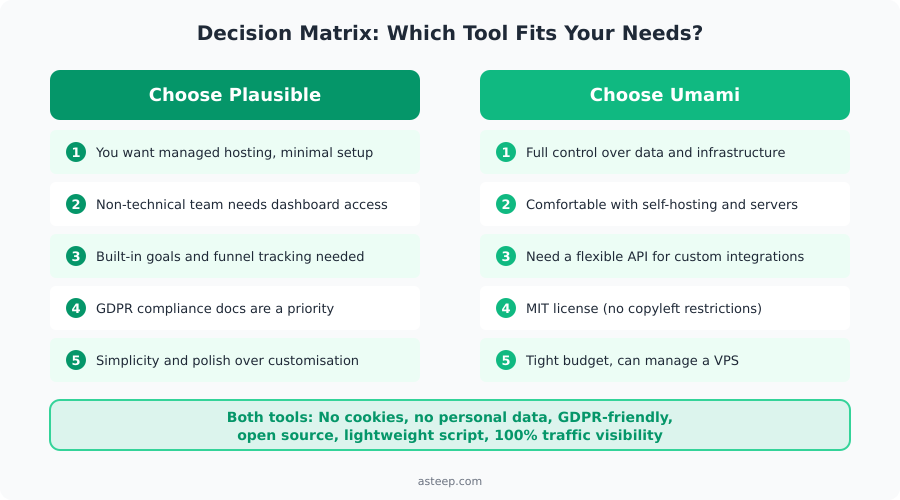
Both tools let you avoid cookie consent banners entirely, which means you see 100% of your traffic rather than only the visitors who click “accept.”
Self-Hosting and Control
This is where the tools diverge most clearly.
Umami was built for self-hosting. The documentation covers installation on various platforms, and the community around self-hosted deployments is active. You can run it on a basic VPS, in Docker, or on platforms like Vercel or Railway. The MIT license means no restrictions — you can modify the source code however you want.
Plausible offers self-hosting through their Community Edition, but the experience is different. It runs in Docker and requires more resources than Umami. Some features available in Plausible Cloud (like certain integrations) may not be in the self-hosted version. The AGPL license also means that if you modify the code and offer it as a service, you must open-source your changes.
If self-hosting is your primary goal, Umami has the edge. It’s lighter, more flexible, and the license is more permissive.
Pricing
For hosted/cloud versions:
| Plan | Plausible Cloud | Umami Cloud |
|---|---|---|
| Entry | $9/mo (10K pageviews) | $9/mo (100K events) |
| Mid-tier | $19/mo (100K pageviews) | $19/mo (1M events) |
| Scale | Custom pricing | $49/mo (5M events) |
| Self-hosted | Free (Community Edition) | Free |
Note: Plausible counts pageviews; Umami counts events (which include pageviews plus custom events). Depending on how many custom events you fire, the effective value can differ significantly.
For self-hosted deployments, your only costs are server infrastructure. I’ve run Umami on servers costing $5-10/month. Plausible self-hosted typically needs a bit more — plan for $15-20/month minimum due to higher resource requirements from ClickHouse.
Which Should You Choose?
After deploying both tools across different client projects, here’s the framework I use:
Choose Plausible if:
- You want a managed, hosted solution with minimal setup
- Your team includes non-technical stakeholders who need dashboard access
- You need built-in goal tracking and funnel analysis
- GDPR compliance documentation matters (EU company, EU data hosting)
- You value polish and simplicity over customisation
Choose Umami if:
- You want full control over your data and infrastructure
- You’re comfortable self-hosting and have the technical skills
- You need a flexible API for custom integrations
- The MIT license matters to you (no copyleft restrictions)
- You’re running on a tight budget and can manage a VPS
There’s no wrong choice here. Both tools respect user privacy, both give you accurate traffic data without cookies, and both are actively maintained by dedicated teams.
What I tell clients is this: if you just want great analytics that work out of the box, go with Plausible. If you want to own everything and don’t mind getting your hands dirty, go with Umami. Either way, you’re making a better choice than sticking with a tool that requires cookie consent just to count pageviews.
One more angle before you commit: check how each option counts websites, not just pageviews. Plausible’s cloud plans step up by site count — one site on the entry plan, more on the tiers above it. Umami gives you unlimited sites when you self-host, and caps them on its cloud plans. If you would rather not run a server and still stop counting sites, hosted options like Statable put every feature and an unlimited number of websites on the cheapest paid plan, so the price moves only with traffic — a different trade-off (closed source, cloud only), but one number instead of two.

Jonathan Whitaker
Marketing analyst and CXL-certified optimizer with 6+ years of experience in web analytics, conversion optimization, and privacy-first data strategy. Former analytics lead for e-commerce and SaaS companies across North America, now focused on helping businesses make better decisions with less data. Specializes in Plausible, Umami, Matomo, and cookieless analytics. Based in Vancouver, BC.