What Is Marketing Attribution? Models Explained Simply
 Jonathan Whitaker
·
·
8 min read
Jonathan Whitaker
·
·
8 min read

You’re running ads, writing blog posts, sending emails, and posting on social media. A customer finally buys. Which channel gets the credit?
That question is the heart of marketing attribution — and the answer shapes how you spend your budget, what you double down on, and what you cut.
The problem is, most customers don’t convert after a single touchpoint. They read a blog post, see a retargeting ad, open an email, then buy. Attribution models are the rules you use to decide which of those touchpoints actually mattered.
In my experience, teams either overthink attribution (building complex models they can’t trust) or ignore it entirely (defaulting to last-click without realizing it). There’s a middle ground, and that’s what this guide covers.
What Is Marketing Attribution?
Marketing attribution is the process of identifying which marketing touchpoints contribute to a conversion. A conversion could be a purchase, a signup, a demo request — whatever action you’re measuring.
Think of it like this: a customer’s journey is a path with multiple stops. Attribution decides which stops on that path get credit for the final destination.
The reason this matters is budget allocation. If you believe paid search drives all your conversions, you’ll pour money into it. But if organic content actually introduced most of those customers to your brand, you’re undervaluing a channel that deserves more investment. Understanding organic traffic and its true value is often the first step toward better attribution.
Attribution also helps you understand the sequence of touchpoints. It’s not just about which channels are involved — it’s about how they work together.
Common Attribution Models
There are several standard models for distributing conversion credit. Each one has a different philosophy about what matters most in the customer journey.
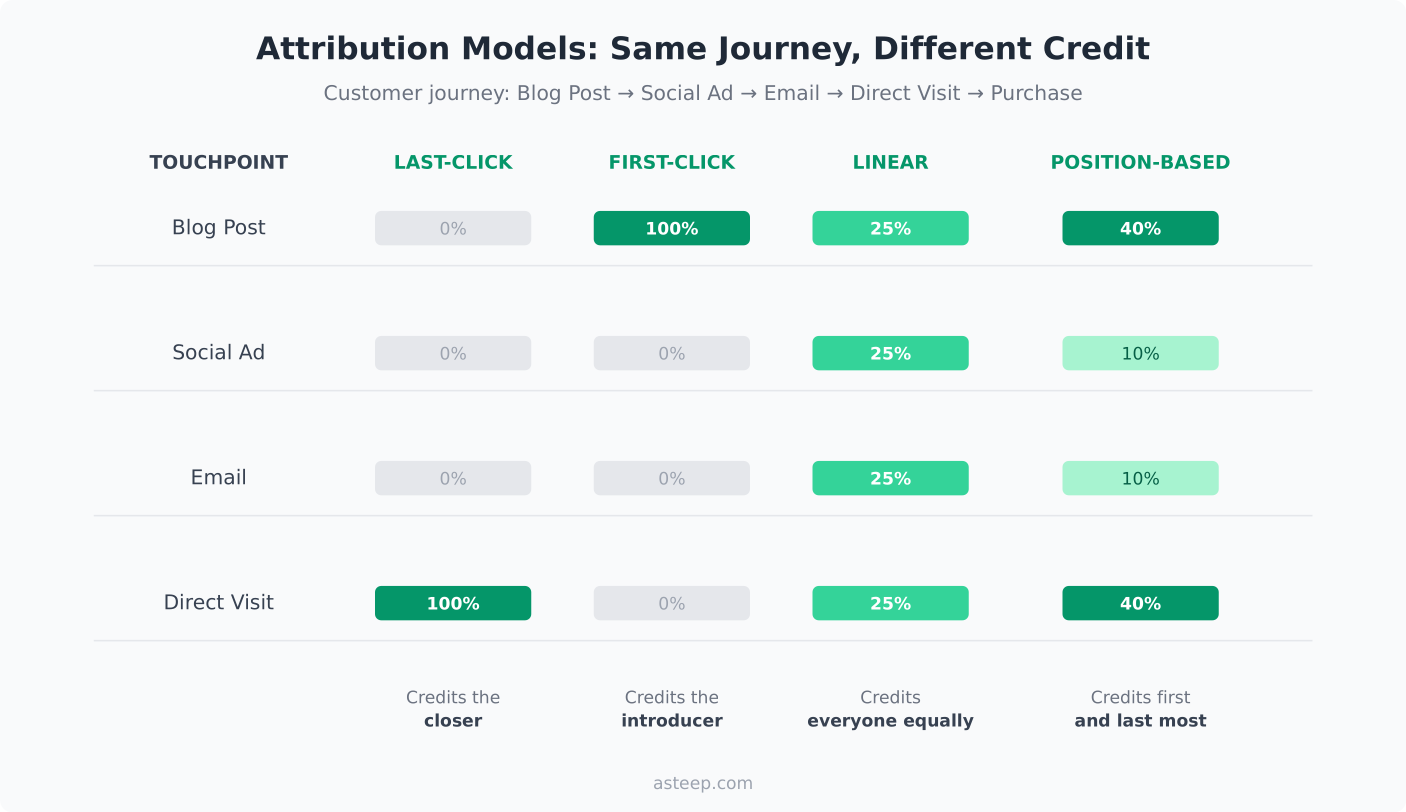
I’ll walk through each using the same example: a customer who discovers your brand through a blog post, clicks a social media ad, opens an email, and then converts through a direct visit.
Last-Click Attribution
Last-click gives 100% of the credit to the final touchpoint before conversion. In our example, the direct visit gets all the credit.
This is the default in most analytics tools, and it’s the model teams use without even realizing they’ve chosen it. It’s simple and easy to implement.
The downside is obvious: it ignores everything that happened before the final click. The blog post that introduced the customer? The ad that brought them back? Zero credit. Last-click systematically undervalues awareness and consideration channels.
First-Click Attribution
First-click is the opposite — it gives 100% of the credit to the first touchpoint. In our example, the blog post gets everything.
This model values discovery. It answers the question, “What brought this customer into our world?” That’s useful if you’re focused on growing your audience and measuring top-of-funnel effectiveness.
But it has the same fundamental flaw as last-click, just in reverse. It ignores the nurturing and re-engagement that often make the conversion possible.
Linear Attribution
Linear attribution splits credit equally across all touchpoints. Each of our four touchpoints gets 25% credit.
It’s the “fair” model — everyone gets the same share. This is better than single-touch models because at least it acknowledges the full journey.
The thing most guides don’t tell you: linear attribution sounds reasonable but gives you weak signals. When everything gets equal credit, nothing stands out. You can’t identify which channels are actually moving the needle versus which ones are just along for the ride.
Time-Decay Attribution
Time-decay gives more credit to touchpoints closer to the conversion. The direct visit gets the most credit, the email gets a bit less, the social ad even less, and the blog post the least.
The logic here is that interactions closer to the purchase moment had more influence on the decision. There’s some truth to this — a customer clicking your email the day before they buy is probably more relevant than a blog post they read three weeks ago.
This model works well for short sales cycles where recent touchpoints genuinely are more influential. It’s less useful for businesses with long consideration phases where early touchpoints do the heavy lifting.
Position-Based (U-Shaped) Attribution
Position-based attribution gives 40% credit to the first touchpoint, 40% to the last, and splits the remaining 20% among everything in between. In our example, the blog post and direct visit each get 40%, while the social ad and email split the remaining 20%.
The idea is that the first touch (introduction) and the last touch (conversion) matter most, with the middle touchpoints playing a supporting role.
I’ve seen this model work well for B2B companies with defined funnels. It acknowledges both acquisition and conversion while still giving some credit to nurturing. The Wikipedia entry on marketing attribution provides a solid overview of how these models evolved.
Which Model Should You Use?
Here’s the honest answer: it depends on your business, and no model is perfectly accurate.
Start with these questions:
- How long is your sales cycle? Short cycles (days) work fine with last-click or time-decay. Longer cycles (weeks or months) need multi-touch models.
- How many channels do you use? If you only run two or three channels, complex multi-touch models add overhead without much insight. If you run eight or ten channels, single-touch models will mislead you.
- What decision are you trying to make? If you need to know where to find new customers, lean toward first-click. If you need to know what closes deals, lean toward last-click or time-decay.
The thing most guides don’t tell you is that switching models changes your numbers dramatically — but it doesn’t change reality. Your customers took the same journeys regardless of which model you apply. The model is a lens, not a fact.
What I’ve seen work best is running two models side by side: a single-touch model for simplicity and a multi-touch model for nuance. When both models agree that a channel is performing well, you can invest confidently. When they disagree, that’s where interesting questions live.
If you’re also working on improving what happens after the click, conversion rate optimization best practices can help you make every attributed touchpoint count.
Attribution in a Privacy-First World
Here’s where attribution gets complicated — and where most traditional guides fall apart.
Modern privacy changes are breaking the data that attribution models rely on. Cookie restrictions, iOS tracking prevention, ad blockers, and regulations like GDPR and CCPA all reduce the number of touchpoints you can observe. When you can’t see the full journey, every attribution model becomes less accurate.
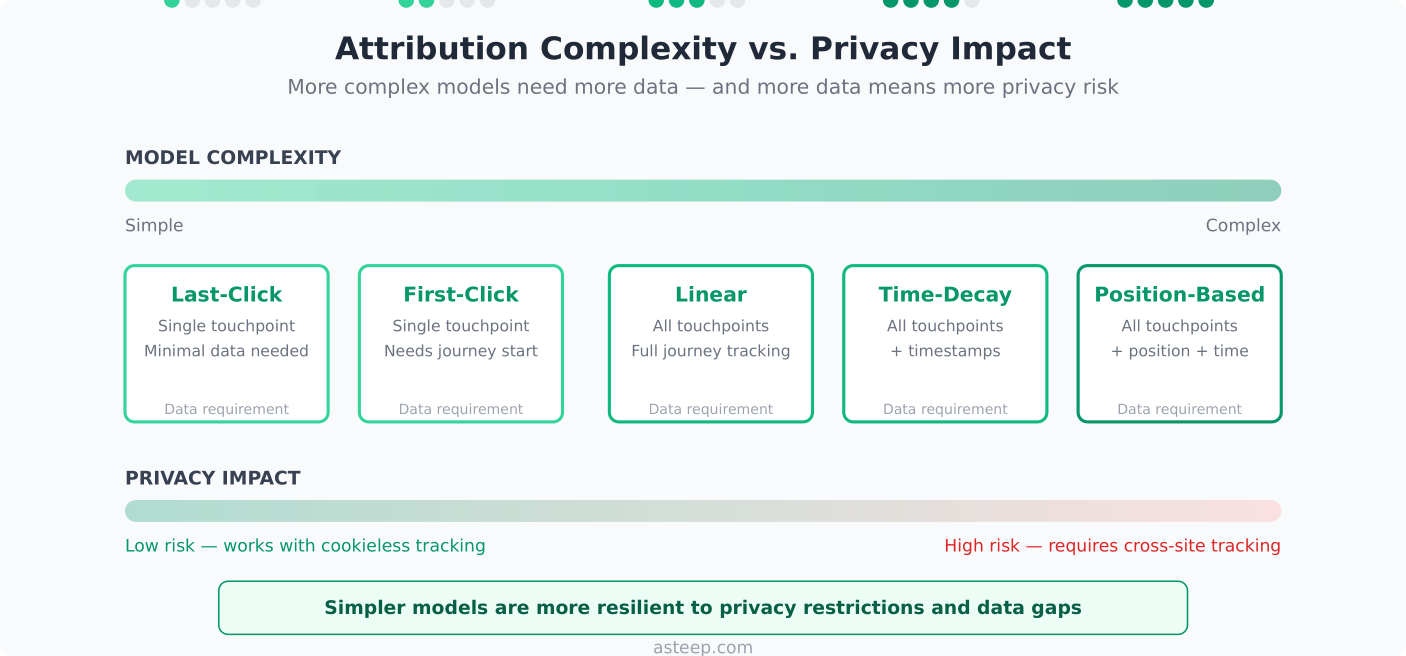
The more complex your attribution model, the more data it needs. And the more data it needs, the more it’s affected by privacy restrictions. A sophisticated multi-touch attribution setup that worked in 2019 might be producing unreliable results today simply because it’s missing 30-40% of the touchpoints.
This is actually an argument for simpler models. Last-click attribution, for all its flaws, at least works with the data you can reliably collect. You know the customer clicked and converted — that part of the journey is still visible.
Privacy-first analytics tools like Plausible, Umami, and Matomo handle this differently. They focus on first-party data and cookieless tracking, which means the data they do collect is more reliable — even if there’s less of it.
I’ve made this mistake myself: building elaborate attribution models on shaky data. The reports looked impressive, but the insights were unreliable. Simpler tracking with cleaner data beat complex tracking with gaps every time.
A Simpler Approach That Works
After years of working with attribution models across different team sizes, here’s the practical approach I recommend:
1. Get your source tracking right first. Use UTM parameters consistently. Make sure every campaign, ad, and link is tagged properly. You can’t attribute what you can’t identify.
2. Start with last-click, but don’t stop there. Last-click is your baseline. It’s imperfect but consistent. Use it for day-to-day decisions while you build a more complete picture.
3. Layer in first-click data. Compare your first-click and last-click reports. Channels that show up strongly in first-click but weakly in last-click are your awareness drivers. Channels that show up in last-click but not first-click are your closers. This two-model comparison often tells you more than any sophisticated algorithm.
4. Use cohort analysis for the big picture. Instead of trying to trace every individual journey, look at groups. Cohort analysis can show you whether customers who entered through organic search retain better than those from paid ads — without needing to track every single touchpoint.
5. Accept imperfection. No attribution model captures the full picture. A customer might hear about you from a friend, see your brand on a podcast, and then search your name directly. You’ll only see the direct search. That’s OK. Attribution is a useful approximation, not a precise measurement.
The best attribution setup isn’t the most complex one. It’s the one your team actually uses to make better decisions. A simple model you trust beats a sophisticated one you don’t.
Jonathan Whitaker
Marketing analyst and CXL-certified optimizer with 6+ years of experience in web analytics, conversion optimization, and privacy-first data strategy. Former analytics lead for e-commerce and SaaS companies across North America, now focused on helping businesses make better decisions with less data. Specializes in Plausible, Umami, Matomo, and cookieless analytics. Based in Vancouver, BC.