First-Party Data: The Only Data Strategy That Lasts
 Jonathan Whitaker
·
·
7 min read
Jonathan Whitaker
·
·
7 min read

Third-party cookies are dead. Third-party data is next. If your analytics strategy depends on either, it’s time to rethink.
I’ve watched companies scramble every time a browser update or privacy regulation invalidates their tracking setup. The pattern is always the same: panic, patch, repeat. Meanwhile, the teams that invested in first-party data barely flinched.
This isn’t about following a trend. It’s about building on ground you actually own.
First-Party vs Third-Party Data
The distinction is simple but critical.
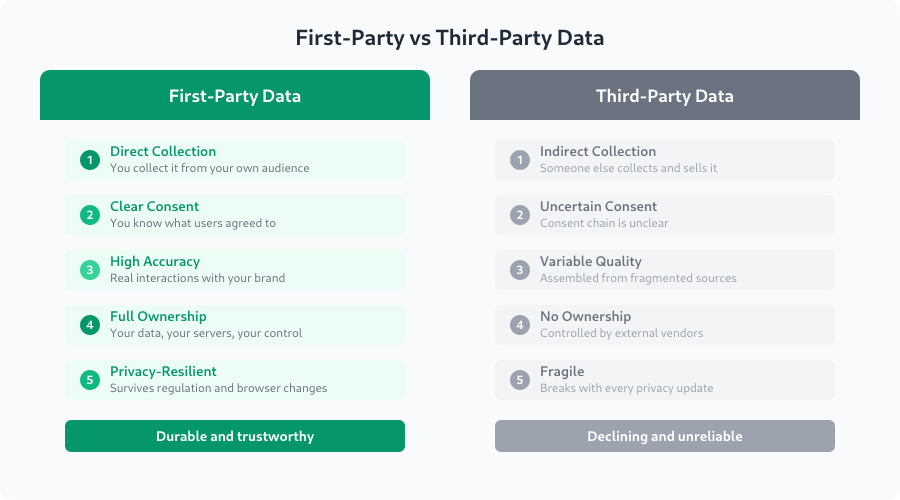
First-party data is information you collect directly from your audience through your own channels. A form submission on your website, a purchase in your store, a support ticket from your customer. You asked for it, they gave it to you, and you control it.
Third-party data is collected by someone else and sold or shared with you. Ad networks tracking users across sites, data brokers assembling profiles from dozens of sources, cookie-based audiences you bought from a marketplace. You don’t control the collection, the quality, or the consent.
There’s also second-party data, which is essentially someone else’s first-party data shared through a direct partnership. It’s a middle ground, but not the focus here.
The key difference isn’t just technical. It’s about trust and durability. When you collect data directly, you know how it was gathered, what consent was given, and how accurate it is. With third-party data, you’re guessing on all three.
Why First-Party Data Wins
Every major privacy shift in the last five years has made third-party data less reliable.
Apple’s Intelligent Tracking Prevention in Safari started the wave. Firefox followed. Chrome finally committed to phasing out third-party cookies. The GDPR and similar regulations made consent mandatory. Each change eroded the value of data you don’t directly collect.
First-party data is resilient to all of this because:
- You control the consent. You know exactly what users agreed to, because you asked them yourself.
- It’s higher quality. Data from your own systems is more accurate than data assembled by third parties from fragmented sources.
- It’s more relevant. Your customers interacting with your product tells you more than a behavioral profile built from unrelated browsing.
- It survives regulatory changes. When you collect data transparently with proper consent, new privacy laws don’t break your strategy.
I’ve made this mistake myself early in my career, building reporting that depended heavily on third-party audience data. When regulations tightened, half those data sources dried up overnight. The first-party metrics, such as on-site behavior and direct customer feedback, kept working without interruption.
What Counts as First-Party Data
First-party data is broader than most people realize. It’s not just email addresses and purchase history.
Behavioral data from your website:
- Pages visited and time spent
- Search queries on your site
- Click patterns and scroll depth
- Content downloads
Transactional data:
- Purchase history and order values
- Cart additions and abandonments
- Subscription activity
- Support interactions
Declared data (what users tell you directly):
- Form submissions and survey responses
- Preference settings and account profiles
- Feedback and reviews
- Newsletter sign-up preferences
The richest first-party data often comes from combining these categories. A user who visits your pricing page three times, downloads a case study, and then submits a demo request tells you far more than any third-party intent signal ever could.
This also connects directly to building meaningful customer segments. The segments you create from first-party data reflect actual behavior on your site, not inferred interests from someone else’s data.
Building a First-Party Data Strategy
You don’t need a massive tech stack to start. What I’ve seen work best is a focused, incremental approach.
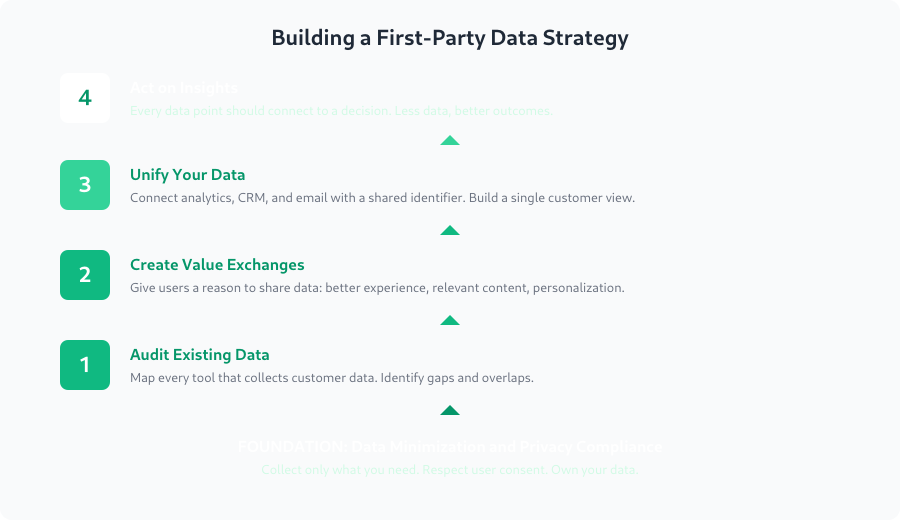
1. Audit what you already have
Most companies are sitting on more first-party data than they realize. Your analytics tool, CRM, email platform, and support system all contain valuable first-party data that’s probably siloed.
Start by listing every tool that touches customer data. Map what each one collects and where the gaps are.
2. Create value exchanges
People share data when they get something in return. A personalized recommendation, a relevant content suggestion, a better product experience. If you’re just asking for information without offering value, expect low participation.
The best value exchanges feel natural, not transactional. A preference center that improves email relevance is a value exchange. A 20-field form gating a two-page PDF is not.
3. Practice data minimization
This might sound counterintuitive in an article about data strategy, but collecting less data actually strengthens your first-party approach. When you only collect what you genuinely need, you reduce compliance risk, improve data quality, and build more trust with your audience.
I’ve seen teams collect dozens of data points they never analyze. That’s not a strategy. That’s a liability.
4. Unify your data
First-party data becomes powerful when it’s connected. A customer’s website behavior, email engagement, and purchase history should live in a single view, not three separate dashboards.
You don’t need a customer data platform on day one. Start simple: make sure your analytics tool, email platform, and CRM share a common identifier.
5. Act on what you collect
The most common failure I see isn’t in collection but in activation. Teams build impressive data pipelines and then never use the insights. Every data point you collect should connect to a decision you’re prepared to make.
Tools That Help
Privacy-first analytics tools are natural partners for a first-party data strategy because they’re designed around the same principles.
- Plausible and Fathom collect website analytics without cookies, keeping everything first-party and privacy-compliant by default.
- Umami gives you self-hosted, cookie-free analytics where you own every byte of data collected.
- Matomo offers full-featured analytics with complete data ownership when self-hosted.
- PostHog combines product analytics with feature flags and session replay, all with a self-hosting option.
The common thread is data ownership. These tools let you collect behavioral insights without relying on third-party tracking infrastructure. Your data stays on your servers, under your control.
It’s also worth revisiting your cookie consent setup. Many consent banners are configured in ways that block even first-party analytics unnecessarily. If your privacy-friendly tool doesn’t use cookies, you may not need a banner for analytics at all.
The Less-Data Advantage
Here’s the part that takes most people by surprise: a first-party data strategy often means working with less data overall, and that’s actually an advantage.
When you depend on third-party data, you end up with massive datasets of questionable quality. You spend more time cleaning and validating than analyzing. The signal-to-noise ratio is terrible.
With first-party data, you have smaller datasets but dramatically higher quality. Every data point represents a real interaction with your brand. You can trust what you’re seeing.
I’ve worked with teams that cut their tracked metrics by 60% when switching to a first-party approach. Their reporting got simpler, their insights got sharper, and their decisions got faster. Less data, better outcomes.
This is the real competitive advantage. While competitors drown in unreliable third-party data, you’re making decisions based on information you can actually trust. Your analytics are resilient to browser changes, regulation updates, and platform shifts.
Industry bodies are increasingly acknowledging this reality. The future of digital marketing measurement runs through first-party relationships, not third-party surveillance.
Start where you are. Audit what you have. Collect only what matters. Build on data you own. That’s a strategy that lasts.
Jonathan Whitaker
Marketing analyst and CXL-certified optimizer with 6+ years of experience in web analytics, conversion optimization, and privacy-first data strategy. Former analytics lead for e-commerce and SaaS companies across North America, now focused on helping businesses make better decisions with less data. Specializes in Plausible, Umami, Matomo, and cookieless analytics. Based in Vancouver, BC.