Not all website visitors are created equal. Some find you through ads. Some click a link on social media. Others type your URL directly into their browser.
Then there’s organic traffic—visitors who find you through search engines like Google, Bing, or DuckDuckGo without you paying for placement. These visitors actively searched for something, found your content in the results, and chose to click.
Understanding organic traffic matters because it’s often your most valuable traffic source: free, sustainable, and full of people already looking for what you offer.
What is organic traffic?
Organic traffic refers to visitors who arrive at your website from unpaid search engine results. When someone searches for “best project management tools” and clicks on a non-ad result, that’s organic traffic.
The “organic” part distinguishes it from paid search results (those marked “Ad” or “Sponsored” at the top of search pages). You didn’t pay for the click—you earned it through your content’s relevance to the search query.
Here’s what makes organic traffic distinctive:
- Intent-driven: Users are actively searching for something specific
- No cost per click: You don’t pay when someone clicks (unlike ads)
- Earned through relevance: Search engines rank you based on content quality and authority
- Sustainable: Good content can drive traffic for months or years
The top organic search result gets approximately 40% of clicks, while the average paid ad gets around 2%. That gap explains why organic traffic is so valuable—users trust organic results more than advertisements.
The five types of website traffic
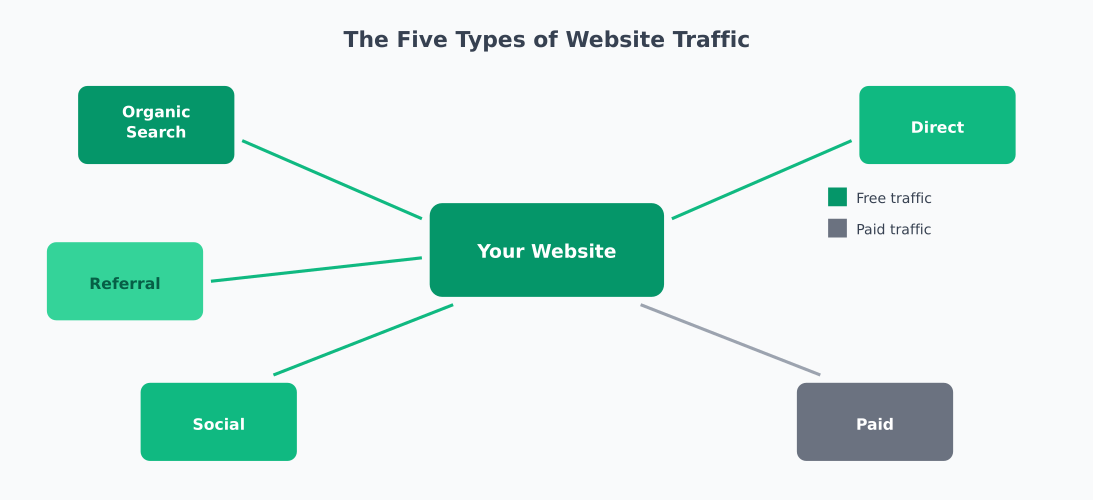
To understand organic traffic’s role, it helps to see the full picture. Most analytics tools categorise traffic into these sources:
1. Organic search
Visitors from unpaid search engine results. They searched for something, saw your page listed, and clicked. This is what we’ve been discussing—the traffic you earn through SEO (search engine optimisation).
Example: Someone searches “how to write a press release” and clicks on your guide.
2. Direct traffic
Visitors who arrive without a trackable referral source. This typically means they typed your URL directly, used a bookmark, or clicked a link in an email client or app that doesn’t pass referrer data.
Example: A customer types “yourcompany.com” into their browser.
Direct traffic often indicates brand awareness—people know your site well enough to visit directly.
3. Referral traffic
Visitors who clicked a link on another website to reach yours. This could be from a blog that mentioned you, a news article, a directory listing, or any other external site.
Example: A tech blog reviews your product and links to your homepage.
Referral traffic is valuable for understanding which external sites send you visitors and which partnerships or PR efforts are working.
4. Social traffic
Visitors from social media platforms—LinkedIn, Twitter/X, Facebook, Instagram, Reddit, and others. Some analytics tools group this with referral traffic; others break it out separately.
Example: Someone sees your post on LinkedIn and clicks through to your article.
5. Paid traffic
Visitors from advertisements—Google Ads, social media ads, display ads, sponsored content, and similar paid placements. You pay for these clicks, either per click (CPC) or per impression (CPM).
Example: Someone clicks your Google Ads result for “CRM software.”
Paid traffic gives you immediate visibility but stops the moment you stop paying. Organic traffic, by contrast, can compound over time.
Why organic traffic matters
Organic traffic isn’t just free traffic—it has characteristics that make it particularly valuable for most businesses:
It’s cost-effective at scale
Creating content requires upfront investment, but the ongoing cost per visitor approaches zero. A blog post you write today can drive traffic for years without additional spending.
Compare this to paid ads: if you pay £2 per click and want 10,000 monthly visitors, that’s £20,000 per month, every month. An article ranking well organically might cost £500 to create and generate the same traffic indefinitely.
Visitors have intent
Someone who searches “best email marketing software for small business” is actively researching a purchase. They’re not passively scrolling; they’re looking for answers. This intent makes organic visitors more likely to engage, subscribe, or buy than visitors from interruptive channels.
Organic traffic spans the entire funnel:
- Awareness: “What is email marketing?”
- Consideration: “Email marketing vs social media marketing”
- Decision: “Mailchimp vs ConvertKit comparison”
It builds compounding returns
Organic traffic tends to compound. As you publish more quality content, you build domain authority. Higher authority means better rankings for future content. Better rankings mean more traffic, which can lead to more backlinks, which further increases authority.
This flywheel effect is why established sites often dominate search results—they’ve accumulated years of authority that new sites can’t match overnight.
Users trust it more
Studies consistently show that users trust organic results more than paid ads. The 40% vs 2% click-through rate gap isn’t random—users have learned that organic results are often more relevant and trustworthy than sponsored placements.
When you rank organically, you benefit from this implicit trust.
It’s measurable
Unlike some marketing channels, organic traffic is highly measurable. You can track:
- Which pages drive the most organic traffic
- Which search queries bring visitors
- How organic visitors behave on your site
- Conversion rates from organic vs other sources
- Trends over time
This data helps you understand what’s working and where to focus your efforts.
How to measure organic traffic
Every analytics platform tracks organic traffic slightly differently, but the core concept is the same: segment visitors by their source and filter for search engines.
What to look for in your analytics
Most tools categorise traffic sources automatically. Look for reports labelled:
- Acquisition or Traffic Sources
- Channels or Source/Medium
- Search engines or Organic search
Within these reports, you can typically see:
- Total organic sessions over time
- Percentage of total traffic from organic
- Landing pages (which pages visitors arrive on)
- Geographic distribution
- Device types (mobile vs desktop)
Key metrics to track
Organic sessions: The raw count of visits from search engines. Track this over time to see growth trends.
Organic percentage: What share of your total traffic comes from organic search? A healthy content-focused site might see 40-70% organic traffic.
Top landing pages: Which pages attract the most organic visitors? These are your SEO winners—understand what makes them successful.
Bounce rate by source: Do organic visitors engage with your content or leave immediately? High bounce rates might indicate a mismatch between search intent and your content.
Conversions from organic: Ultimately, traffic matters because it drives business outcomes. Track how many organic visitors complete your desired actions (signups, purchases, contact forms).
Understanding search queries
Knowing what people searched for before landing on your site is valuable for understanding intent and optimising content. Some analytics platforms integrate with search console data to show you the actual queries that drive traffic.
Privacy-focused analytics tools handle this differently than traditional platforms, but you can still get meaningful insights about which topics and pages perform best.
Organic traffic vs paid traffic
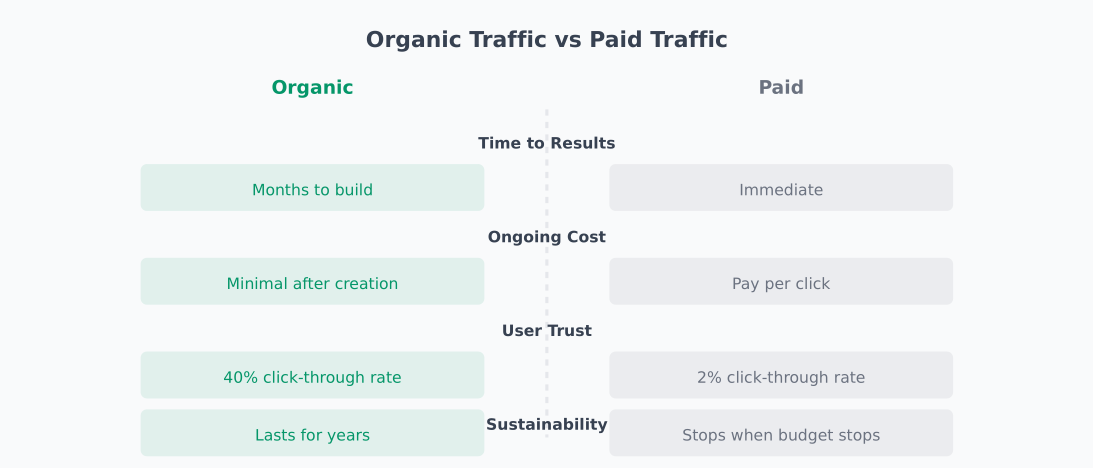
Neither organic nor paid traffic is inherently “better”—they serve different purposes and work best together. Here’s how they compare:
Time to results
Paid: Immediate. Launch an ad campaign today, get traffic today.
Organic: Slow. New content typically takes 3-6 months to rank well, sometimes longer.
Ongoing cost
Paid: You pay for every click. Stop paying, traffic stops.
Organic: Upfront investment in content, but ongoing cost per visitor is minimal.
Control
Paid: High control over targeting, messaging, and placement.
Organic: Limited control. You optimise, but search engines decide rankings.
Trust
Paid: Users know it’s an ad, which creates scepticism.
Organic: Users perceive organic results as more trustworthy.
Sustainability
Paid: Traffic disappears when budget runs out.
Organic: Good content can drive traffic for years.
The practical strategy for most businesses: use paid traffic for immediate needs (product launches, time-sensitive offers) while building organic traffic for sustainable, long-term growth.
What drives organic traffic
Organic traffic comes from ranking well in search results. Understanding what influences rankings helps you attract more organic visitors:
Content quality and relevance
Search engines aim to show users the most helpful results for their query. Content that thoroughly answers what searchers are looking for tends to rank well. This means understanding search intent—what users actually want when they search a phrase—and delivering it clearly.
Backlinks
When other websites link to your content, it signals to search engines that your content is valuable. Quality matters more than quantity—links from authoritative, relevant sites carry more weight than links from low-quality sources.
Technical health
Search engines need to be able to crawl and index your pages. Technical issues like slow load times, broken pages, poor mobile experience, or crawl blocks can hurt rankings regardless of content quality.
Domain authority
Established sites with a history of quality content and backlinks have an advantage. This authority accumulates over time, which is why newer sites often struggle to compete for competitive keywords initially.
User experience signals
How users interact with your site after clicking may influence rankings. If visitors immediately return to search results (“pogo-sticking”), it suggests your content didn’t satisfy their intent.
Common organic traffic mistakes
A few patterns consistently hurt organic traffic growth:
Targeting keywords you can’t win. Competing for “best CRM” when you’re a new site is unrealistic. Start with less competitive, more specific terms and build authority over time.
Ignoring search intent. Ranking for a keyword doesn’t help if your content doesn’t match what searchers want. Study the top-ranking pages for your target keywords—that’s what Google thinks searchers want.
Expecting immediate results. SEO is a long game. If you publish content expecting traffic next week, you’ll likely be disappointed. Plan for months, not days.
Neglecting existing content. Often, updating and improving your current pages generates better returns than creating new content. Pages that rank on page 2 are candidates for optimisation.
Focusing only on traffic, not conversions. 10,000 monthly visitors who never convert matter less than 1,000 visitors who regularly become customers. Track the full funnel.
Related reading
Summary
Organic traffic is visitors who find your website through unpaid search engine results. Unlike paid traffic, you don’t pay per click—you earn visibility through content quality, relevance, and authority.
It matters because:
- It’s cost-effective at scale
- Visitors have active search intent
- Results compound over time
- Users trust organic results more than ads
The trade-off is time. Building organic traffic requires sustained effort over months and years, not days. But for most businesses, that investment creates an asset that continues paying dividends long after the initial work.
Track your organic traffic in your analytics platform, understand which content performs best, and keep improving. The compounding returns make it one of the most valuable marketing investments you can make.