What Is Data Minimisation? A Practical Guide to Collecting Less
 Jonathan Whitaker
·
·
7 min read
Jonathan Whitaker
·
·
7 min read

Every piece of data you collect is a liability. It can be breached, misused, or become a compliance headache. Yet many businesses still operate on a “collect everything, figure it out later” mindset.
Data minimisation flips that approach. Instead of hoarding data you might need someday, you collect only what’s necessary for a specific purpose—and delete it when that purpose is fulfilled.
This isn’t just good ethics. It’s increasingly the law, and it’s often better for your analytics too.
What is data minimisation?
Data minimisation is the practice of limiting data collection to only what’s directly relevant and necessary for a stated purpose. When that purpose is complete, the data should be deleted or anonymised.
The concept is built into major privacy regulations:
- GDPR (EU) — Article 5(1)(c) requires data to be “adequate, relevant and limited to what is necessary”
- CCPA/CPRA (California) — Requires disclosure of what data is collected and why
- LGPD (Brazil) — Mandates collection limited to minimum necessary
- POPIA (South Africa) — Requires data to be adequate, relevant, and not excessive
The common thread: collect less, be intentional about why, and don’t keep it forever.
The four principles of data minimisation
Data minimisation isn’t about collecting nothing—it’s about collecting thoughtfully. Four principles guide the approach:
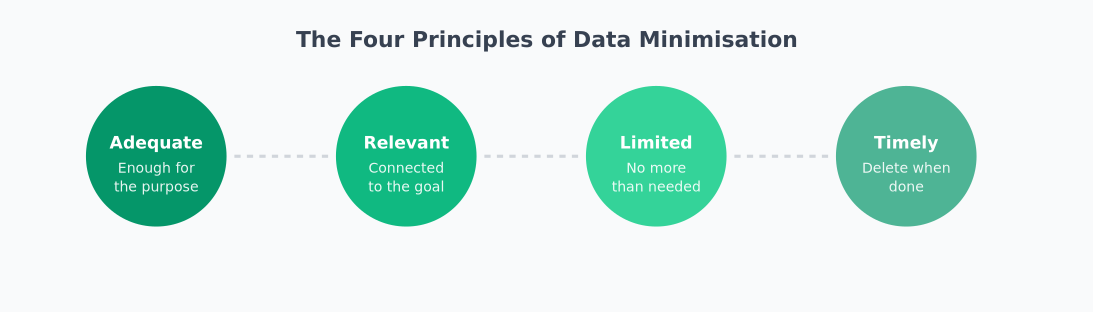
1. Adequate
Collect enough data to achieve your stated purpose. If you’re tracking website performance, you need pageviews and load times. You probably don’t need the user’s full name.
The question to ask: “Do I have what I need to answer my business question?”
2. Relevant
Every data point should connect directly to your purpose. If you’re analysing conversion rates, user location might be relevant (for geo-targeting). Their phone number probably isn’t.
The question to ask: “Does this specific data point help me achieve my goal?”
3. Limited
Avoid collecting more than necessary. This is where most businesses fail—they add fields “just in case” or enable tracking features by default without considering if they’re needed.
The question to ask: “What’s the minimum data I need?”
4. Timely
Data has a shelf life. Analytics from three years ago rarely inform today’s decisions, but they still carry liability. Set retention policies and stick to them.
The question to ask: “How long do I actually need to keep this?”
Why data minimisation matters
Beyond compliance, there are practical business reasons to minimise data collection:
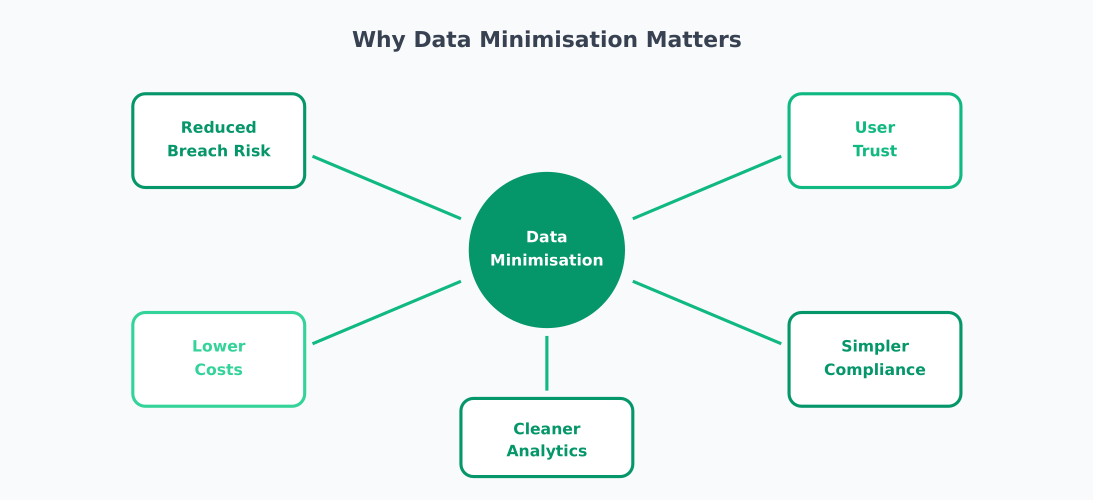
Reduced breach risk
You can’t leak data you don’t have. Every additional data point increases your attack surface. The Equifax breach cost $425 million in settlements—for data they arguably didn’t need to store the way they did.
When you minimise data, you reduce both the likelihood and impact of breaches.
User trust
Privacy-conscious users (and there are more every year) notice when you ask for less. A signup form with two fields signals respect. A form demanding phone number, company size, and industry for a newsletter signup signals the opposite.
Studies consistently show 60-70% of consumers are concerned about how companies use their data. Collecting less is a competitive advantage.
Lower costs
Data storage isn’t free. Neither is securing it, managing it, or responding to subject access requests. The more data you hold, the more infrastructure and process overhead you carry.
Minimising data reduces storage costs, simplifies compliance processes, and speeds up analytics queries.
Cleaner analytics
This might be counterintuitive: collecting less data can improve your analytics. When you’re intentional about what you track, you focus on metrics that matter. Less noise, clearer signals.
I’ve seen teams drown in dashboards tracking everything, unable to identify what actually drives their business. Constraints force focus.
Compliance simplicity
GDPR fines can reach €20 million or 4% of global turnover. Meta was fined €1.2 billion in 2023 for data transfer violations. These aren’t theoretical risks.
When you collect less data, compliance becomes simpler: fewer data points to document, fewer retention schedules to manage, fewer subject access requests to fulfill.
Data minimisation techniques
Here’s how to put the principles into practice:
1. Audit your current collection
Before you can minimise, you need to know what you’re collecting. Map out:
- What data points you collect (forms, analytics, cookies, third-party tools)
- Why you collect each one (stated purpose)
- Where it’s stored
- How long you keep it
- Who has access
You’ll likely find data you forgot you were collecting, stored longer than necessary, accessible to more people than needed.
2. Anonymise or pseudonymise
Not all data needs to identify individuals. Often you can achieve your analytics goals with anonymised or pseudonymised data.
Anonymisation: Remove all identifiers so data can never be linked back to an individual. Irreversible.
Pseudonymisation: Replace identifiers with artificial ones (like hashed IDs). Can be reversed with a key, so still subject to privacy regulations, but reduces risk.
Common techniques:
- IP masking: Store only partial IP addresses (e.g., 192.168.1.xxx)
- Data aggregation: Store totals instead of individual records
- Tokenisation: Replace sensitive values with non-sensitive tokens
- Generalisation: Replace specific values with ranges (age 34 → age 30-40)
3. Set retention limits
Define how long you’ll keep different types of data, then automate deletion.
Example retention policy:
- Raw analytics events: 90 days
- Aggregated reports: 2 years
- User account data: Duration of account + 30 days
- Marketing leads: 12 months without engagement, then delete
The specific periods depend on your business needs and legal requirements. The key is having defined limits rather than keeping everything forever.
4. Implement access controls
Not everyone needs access to all data. Apply role-based access control (RBAC):
- Marketing team sees campaign metrics, not individual user data
- Support team sees customer records they’re actively helping
- Analytics team sees aggregated patterns, not raw events
Fewer people with access means fewer potential breach points and simpler audit trails.
5. Choose privacy-first tools
Your tools make a difference. Some analytics platforms are designed around data maximisation. Others are built with minimisation in mind.
Privacy-first analytics options:
- Plausible — No cookies, no personal data, EU-hosted
- Umami — Open-source, anonymised by default
- Fathom — Cookie-free, GDPR compliant out of the box
- Matomo — Self-hosted option, configurable anonymisation
These tools prove you don’t need invasive tracking to understand your website performance.
The trade-offs
Data minimisation isn’t free. Here’s what you might give up:
Less granular personalisation
If you don’t track detailed user behaviour, you can’t personalise as deeply. You might not know that User #4521 prefers blue buttons and reads your blog on Tuesdays.
For most businesses, this level of personalisation isn’t necessary anyway. Segment-level insights (mobile users, return visitors, geographic regions) are usually sufficient.
Harder attribution
Without persistent user IDs and cross-device tracking, multi-touch attribution becomes harder. You might not trace a conversion back through a 30-day, 12-touchpoint journey.
But attribution was always messier than the dashboards suggested. First-party data and direct feedback often provide more reliable insights than complex tracking.
Historical analysis limitations
With retention limits, you can’t query five years of raw data for trends. You need to plan ahead—aggregate what you’ll need before deleting granular records.
In practice, most historical analysis uses aggregated data anyway. Weekly/monthly summaries typically answer the questions you actually have.
Getting started
Data minimisation doesn’t require a complete overhaul. Start with these steps:
- Audit one system — Pick your analytics tool or main form and document what you’re collecting
- Ask “do I need this?” for each data point — If you can’t articulate a specific use, consider removing it
- Enable anonymisation features — Most analytics tools have IP masking and similar options; turn them on
- Set one retention policy — Pick a data type and define when it gets deleted
- Expand gradually — Apply the same process to other systems over time
You don’t need to achieve perfect minimisation on day one. Each step reduces risk and builds toward a more intentional approach to data.
Related reading
Summary
Data minimisation is about collecting data with intention rather than accumulating it by default.
The principles are straightforward:
- Collect only what you need (adequate and relevant)
- Avoid collecting more than necessary (limited)
- Delete data when its purpose is fulfilled (timely)
The benefits are real: reduced breach risk, user trust, lower costs, cleaner analytics, and simpler compliance.
Yes, there are trade-offs. You might lose some personalisation granularity and attribution detail. But for most businesses, what you gain in trust and reduced liability far outweighs what you give up.
Start small. Audit one system. Ask “do I need this?” for each field. The habit of intentional data collection builds from there.
Jonathan Whitaker
Marketing analyst and CXL-certified optimizer with 6+ years of experience in web analytics, conversion optimization, and privacy-first data strategy. Former analytics lead for e-commerce and SaaS companies across North America, now focused on helping businesses make better decisions with less data. Specializes in Plausible, Umami, Matomo, and cookieless analytics. Based in Vancouver, BC.