What Is a Conversion Funnel? A Practical Guide to Funnel Analysis
 Jonathan Whitaker
·
·
5 min read
Jonathan Whitaker
·
·
5 min read

Most visitors who land on your site never do the thing you want them to do. They arrive, look around, and leave. A conversion funnel is how you figure out where they’re slipping away — and what to fix.
The idea is simple: people move through stages on the way to converting, and at each stage some of them drop off. Map those stages, measure the drop-off, and you stop guessing about what’s broken. You can see it.
This guide explains what a conversion funnel is, how to build one, and how to read it without overcomplicating things.
What Is a Conversion Funnel?
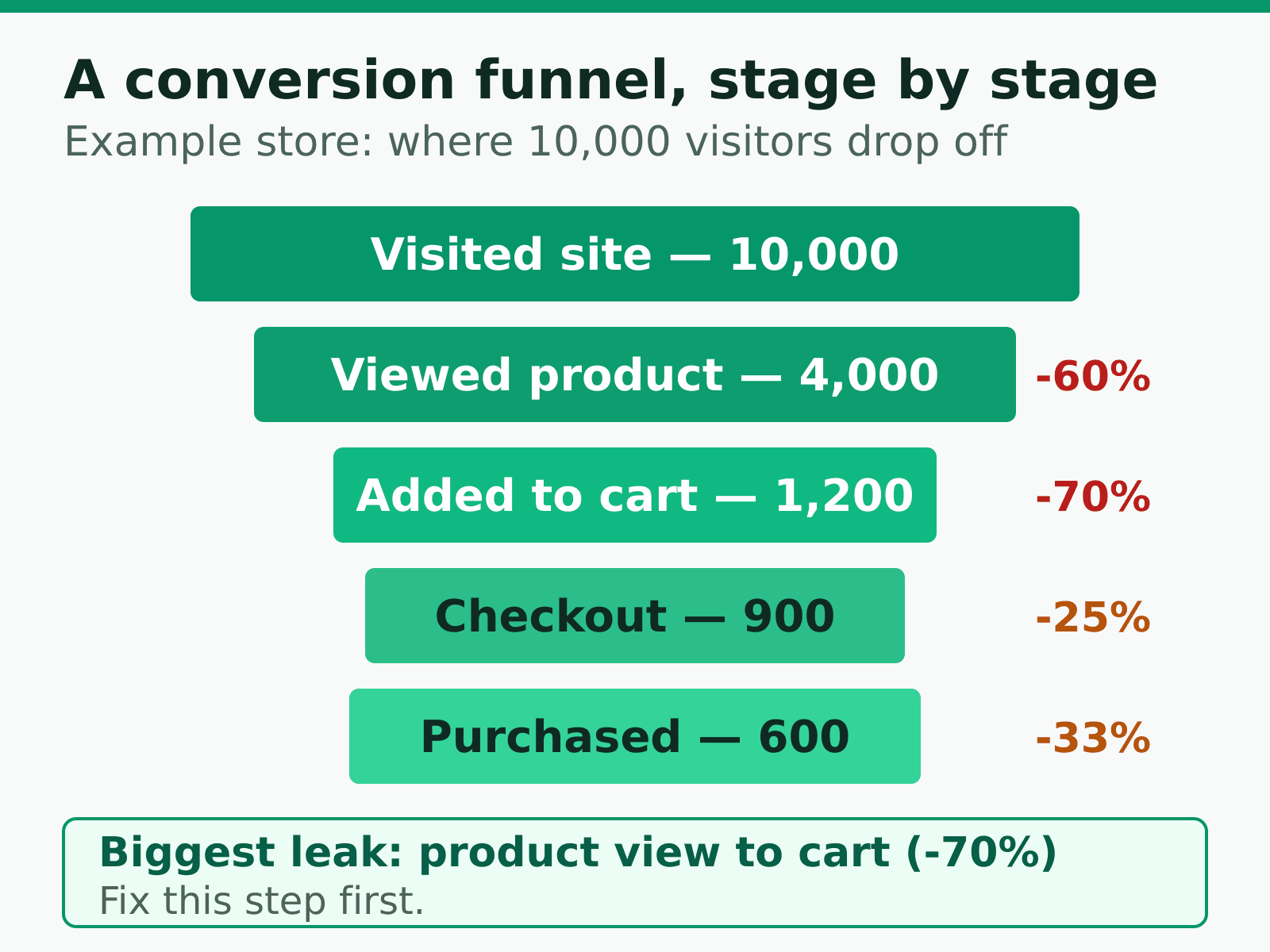
A conversion funnel is a model of the steps a visitor takes toward a goal — a purchase, a signup, a demo request, whatever counts as a conversion for you.
It’s called a funnel because the shape narrows. Many people enter at the top; fewer reach each stage; only some convert at the bottom. The narrowing isn’t a failure — it’s expected. The point is to understand how much it narrows and where.
A classic e-commerce funnel looks like this:
- Visit the site
- View a product
- Add to cart
- Start checkout
- Complete purchase
Each step is a gate. The funnel shows you how many people pass through each one — and, more usefully, how many don’t.
Why Funnels Are Worth Building
A single conversion rate tells you whether things are good or bad. A funnel tells you why.
“3% of visitors convert” is a verdict. A funnel turns it into a diagnosis.
Say your overall conversion rate is low. Without a funnel, you’re guessing — is it the product pages, the cart, the checkout? With a funnel, you can see that 60% of people add to cart but only 10% finish checkout. Now you know exactly where to look.
That’s the real value: a funnel turns a vague problem into a specific one. And specific problems are fixable.
How to Build a Conversion Funnel
You don’t need fancy software to start. You need a clear goal and the steps that lead to it.
Step 1: Define the conversion
Pick one goal per funnel. Trying to track three conversions in one funnel muddies everything. Start with the one that matters most — a sale, a signup, a booking.
Step 2: Map the steps
List the realistic stages a visitor passes through to reach that goal. Keep it to the meaningful ones. Three to five steps is usually right; ten is too granular to act on.
Step 3: Pick the events to measure
Each step needs something measurable — a pageview, a button click, a form submission. Privacy-first tools like Plausible, Umami, and Matomo let you define these as goals or custom events without cookies, which keeps your tracking clean and compliant.
Step 4: Set up the tracking
Configure each event in your analytics tool, then let real traffic flow through. Resist the urge to analyse on day one — you need enough visitors at each stage for the numbers to mean anything.
How to Read a Funnel Report
Once data starts coming in, you’re looking for one thing above all: the biggest drop-off.
| Step | Users | Drop-off |
|---|---|---|
| Visited site | 10,000 | — |
| Viewed product | 4,000 | 60% |
| Added to cart | 1,200 | 70% |
| Started checkout | 900 | 25% |
| Completed purchase | 600 | 33% |
In this example, the biggest leak is between “viewed product” and “added to cart” — a 70% drop. That’s where I’d focus first. Maybe pricing isn’t clear, maybe the product pages don’t answer key questions, maybe the add-to-cart button is hard to find.
The thing most guides don’t tell you: don’t try to fix every drop-off at once. Some narrowing is normal at every stage. Find the worst step relative to what’s reasonable, fix that, then re-measure. One change at a time keeps your analysis honest.
Funnels and Segmentation
The same funnel can behave completely differently for different groups. Mobile users might drop off at checkout far more than desktop users. Visitors from a particular campaign might convert at twice the rate of organic traffic.
Looking at your funnel by customer segment often reveals problems the overall view hides. A funnel that looks fine on average can be quietly broken for half your audience.
Common Funnel Mistakes
- Too many steps. Over-granular funnels create noise. Track the stages you can actually act on.
- Analysing too early. With too little traffic, normal variation looks like a trend. Wait for a meaningful sample.
- Fixing the wrong leak. A small drop-off at a low-traffic step matters less than a big one early on. Prioritise by impact, not by order.
- Ignoring segments. Averages hide problems. Always check whether a key group behaves differently.
The Bottom Line
A conversion funnel is one of the most practical tools in analytics because it turns “our conversion rate is low” into “here’s exactly where people leave.” That shift — from verdict to diagnosis — is what makes it worth the setup.
Define one goal, map the real steps, measure each one, and hunt for the biggest leak. Fix it, re-measure, repeat. You don’t need complex tools or invasive tracking to do this well — just a clear funnel and the patience to let the data steep before you act.
Jonathan Whitaker
Marketing analyst and CXL-certified optimizer with 6+ years of experience in web analytics, conversion optimization, and privacy-first data strategy. Former analytics lead for e-commerce and SaaS companies across North America, now focused on helping businesses make better decisions with less data. Specializes in Plausible, Umami, Matomo, and cookieless analytics. Based in Vancouver, BC.